Contact Us
Updates on the US Export Market
Your Economic Update for the US Market
The USA remains the key market for Styrian exporters – but trade policy, tariff rates, and regulations are changing rapidly. Which new US investment programs are being launched? Where do bureaucratic hurdles threaten, and where do fresh opportunities arise for your US business?
In our US Watch, we continuously collect and compile relevant findings, tariff outlooks, and economic shorts. Concise, precise, and directly categorized – so you always maintain an overview when entering the market, exporting, and investing in the USA.
Current Developments from the USA
US trade policy remains clearly protectionist in 2026. Since Donald Trump’s second term, the USA has significantly tightened its tariff policy, increasingly targeting traditional trading partners like the EU, Canada, and Mexico, in addition to China.
Although the average effective US tariff burden has decreased again after its peak of around 18% in 2025, it stood at 9.6% in April 2026, according to the OECD, still significantly above the 2024 level of only 2.6%. Austria is disproportionately affected: Austrian goods currently face an effective US import tariff of approximately 11%.
This is particularly relevant because the USA remains a central sales market for Austria. In 2025, 6.7% of Austria’s total exports went to the United States, making the USA Austria’s second most important export market after Germany. At the same time, Austrian exports to the USA decreased by more than 21% in 2025.
What does this mean for Styrian companies?
The higher tariffs increase price and margin pressure in US business, making precise calculation of total import costs even more crucial. Export-oriented companies, in particular, should therefore incorporate tariff developments into their pricing, contracts, and US market strategy at an early stage. At the same time, the development shows that protectionism also has a price for the US economy: according to analyses summarized by the WKO, the new tariffs have increased costs for US consumers and businesses without adequately strengthening employment in US industry.
The US market remains strategically important for Austrian and Styrian companies, but it has become significantly more demanding in terms of trade policy. It would be important for companies to continuously monitor tariff costs and regulatory developments, while also examining how they can make their positioning, supply chains, and market strategy more robust against trade policy changes.
Strasbourg, June 16, 2026 – The European Parliament has cleared the way for the implementation of the EU-US tariff agreement. Members of Parliament in Strasbourg voted in favor of the temporary abolition of European tariffs on numerous US industrial goods, including cars and machinery. This removes the last significant political hurdle at the EU level.
Formally, the Council of the European Union must still approve. However, this step is expected before the deadline set by US President Donald Trump on July 4.
The tariff exemption is to apply upon the entry into force of the corresponding legislation and is initially limited until December 31, 2029. It forms the central component of the trade framework agreed between the European Union and the United States in summer 2025. In return, the US government pledged to apply a maximum tariff rate of 15 percent on most EU products. At the same time, safeguard mechanisms were enshrined in the law, allowing the EU to suspend tariff concessions if the agreement is not adhered to by the US side.
At the beginning of the month, the Styrian technology group ANDRITZ received an order from the New York Power Authority (NYPA) to design, manufacture, and supply five new generator stators for the Niagara Project power plant – the third-largest hydropower facility in the USA. The project is part of the “Next Generation Niagara” modernization program.
From an economic perspective, this is a clear signal for the US market. NYPA is specifically investing in the modernization of critical energy infrastructure to ensure a reliable and CO₂-free power supply for decades to come. ANDRITZ not only supplies important technical components but also positions itself in areas such as modernization, digitalization, and lifecycle services – precisely where Styrian industrial companies have particularly good opportunities in the USA. According to ANDRITZ, the project duration is approximately ten years.
Despite political and regulatory uncertainties, the US market continues to offer attractive potential for Styrian companies in energy, environmental, automation, and industrial technology. The major order indicates that Styrian technology has particularly good opportunities in the US market, especially where states invest in renewable energy, grid infrastructure, and modernization. Domestic companies should increasingly view the US market not only as a sales market but also as a project and transformation market.
On March 19, the European Parliament’s Committee on International Trade advanced legislation to implement central parts of the EU-USA trade deal with 29 votes to 9. This marks the next step towards implementing the EU-US trade deal, signaling progress but not a breakthrough. In terms of content, the agreement remains manageable: the EU is to largely reduce tariffs on industrial goods, while US products – particularly in the agricultural sector – will gain better market access.
However, confidence in the USA is limited given recent trade policy tensions, and the EU is acting cautiously. So-called “Sunrise” mechanisms link tariff reductions to the actual compliance with the agreement by the USA. This provides a safeguard for Europe and also signals a new approach in trade policy – cooperation, yes, but only under clear conditions.
However, the structural imbalance remains critical. While the EU offers far-reaching openings, significant tariffs persist in the USA. This underscores that it is less a classic free trade agreement than a geopolitically motivated arrangement primarily serving to stabilize transatlantic relations.
The decision is thus an interim step, with further political hurdles ahead.
The U.S. Supreme Court’s ruling against the Trump tariffs based on IEEPA has not fundamentally eased the situation for Styrian exporters. Although these tariffs were declared unlawful, the US administration immediately responded with a new 10% tariff under Section 122 of the Trade Act of 1974 and additionally initiated new Section 301 investigations.
For Styrian companies, this primarily means: the legal basis has changed, but economic uncertainty persists. Many European companies are currently examining with their US partners whether already paid tariffs can be reimbursed. It is particularly difficult that often only the respective US importer of record can apply for refunds. This creates additional coordination needs along the supply chain and also harbors potential for conflict between exporters, importers, and distributors.
Even with possible repayments, the situation has not yet been definitively clarified. Although the Court of International Trade (CIT) ordered on March 4, 2026, that the US Customs Authority should stop collecting IEEPA tariffs and prepare for reversals in certain cases – this order was initially suspended. US Customs and Border Protection (CBP) is working on an electronic refund system via its ACE platform. However, it is already clear: the process will be technically and administratively complex, and significant questions remain open for imports that have already been definitively assessed.
For export-oriented businesses in Styria, the US market remains attractive, but it has become significantly more volatile in terms of tariffs and legal aspects. Crucial now are thorough documentation, the examination of possible refunds, and pricing and contract models that take new tariff risks into account. The U.S. Supreme Court’s ruling therefore does not bring quick relief, but rather marks the beginning of a new transition phase in US trade.
The Supreme Court of the United States’ ruling on February 20, 2026, fundamentally impacted US trade policy. The court declared import tariffs introduced by the US government based on the International Emergency Economic Powers Act (IEEPA) unlawful. The tariffs in question were discontinued, but at the same time, the US government introduced new measures, including a 10% tariff surcharge under Section 122 of the Trade Act of 1974.
For export-oriented companies, especially from Europe and Austria, this means another adjustment of the tariff structure in US business. While some products continue to fall under existing sectoral measures such as Section 232 tariffs (e.g., on steel or aluminum), many other goods now face additional import costs and new compliance requirements. At the same time, the situation remains fluid. Further trade policy instruments such as Section 301 investigations or additional safeguard tariffs could follow in the coming months.
In the webinar recording, you will receive an overview of current US tariff policy, legal backgrounds, and the practical implications for companies. It explains which tariffs are currently actually in force, what exceptions exist, and what steps companies should take to minimize risks or secure possible refunds of already paid tariffs.
Link to the webinar recording
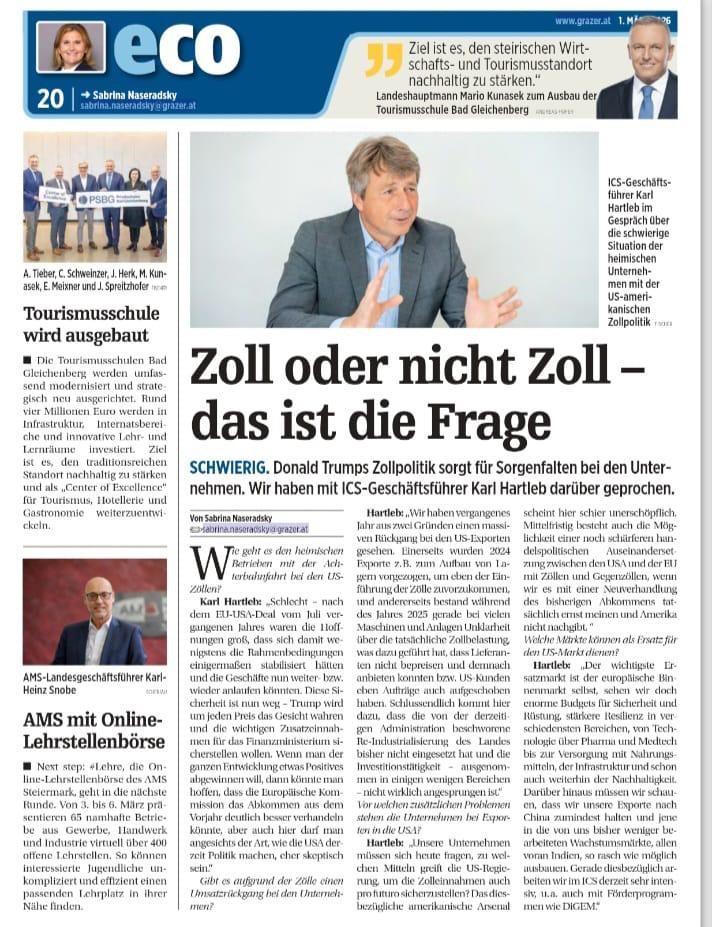
US tariff policy is causing noticeable uncertainty in Styrian export businesses. Between new trade barriers, global power shifts, and strategic realignments, companies face crucial decisions.
How great is the actual pressure? Which sectors are particularly affected? And what opportunities arise despite all challenges?
ICS Managing Director Karl Hartleb provides context, analyzes backgrounds – and shows why strategic clarity is more important than ever.
On February 20, 2026, the US Supreme Court, in a 6-3 decision, declared the “reciprocal” tariffs imposed by President Donald Trump based on the International Emergency Economic Powers Act (IEEPA) unlawful. The court clarified that the President’s authority to “regulate imports” under IEEPA does not constitute an independent authorization to impose tariffs. This competence remains with Congress. Affected are those tariffs that have been based on IEEPA since the so-called “Liberation Day” in April 2025 against almost all US trading partners. Other tariff measures based on different legal grounds, such as Section 232 (for steel and aluminum), Section 201, or Section 301, remain unaffected. The politically agreed EU-US framework agreement with 15% US tariffs on most EU goods also remains in force for now.
For export-oriented companies in Austria and Styria, the ruling primarily means legal and planning certainty during a transition phase, but no immediate relief. The US administration has already announced its intention to quickly re-establish the previous tariff structures through other legal instruments and to maintain existing bilateral agreements. At the same time, it remains unclear whether and to what extent already paid IEEPA tariffs will be reimbursed. The U.S. Court of International Trade (CIT) is expected to be responsible for this. Styrian companies should therefore secure import documents together with their US importers, check possible refund volumes, and keep an eye on deadlines.
The US market thus remains an important, but politically volatile target market. For Styrian companies, it is crucial to integrate tariff and legal issues into their US strategy – from pricing and contract design to cooperation with US partners and the evaluation of future investments.
The Foreign Trade Center Washington will deepen these assessments in the ad-hoc webinar “US Trade Policy 2026: Supreme Court Ruling and Impact on US Tariff Policy – WKO” on March 3, 2026.
You are currently viewing a placeholder content from Default. To access the actual content, click the button below. Please note that doing so will share data with third-party providers.


 16. November 2026
 Silicon Valley
 On Site
 © Christof Hütter Photography
Archive 2024-2025
The USA is experiencing a historic high in tariff revenues: According to U.S. Customs and Border Protection (CBP), over 200 billion USD in tariffs were collected between January 20 and December 15, 2025. This is due to more than 40 presidential Executive Orders by which President Trump raised tariffs on a wide range of imports. Tariffs now account for an estimated 5–7% of total federal tax revenues – about twice as much as before these measures.
What does this mean for Styrian companies?
- US market remains attractive, but becomes more expensive and complex:
Styrian products from mechanical engineering, automotive, industrial equipment, measurement/control technology, or medical technology automatically become more expensive due to higher tariffs.
- Competition intensifies:
US customers are increasingly exploring alternatives, such as local suppliers or suppliers from countries with more favorable tariff conditions or special agreements.
- Planning and legal uncertainty increases:
Ongoing legal proceedings and political debates make it difficult to assess which tariffs will apply for how long. This burdens long-term contracts, investment decisions, and location planning.
- Opportunities in niches remain:
Technologically leading Styrian companies (e.g., in special machinery, automation, environmental technology, or niche components) can continue to assert themselves if they prioritize service, digitalization, and clear efficiency gains (e.g., lower energy, maintenance, and personnel costs).
Conclusion: The US market remains an important, but increasingly demanding target market. Success depends more than ever on clear positioning, cost, and risk management.
The Trump administration has introduced a new fee of $100,000 per H-1B visa application, applicable to applicants located outside the USA. Officially, the measure targets the misuse of the H-1B program in the tech industry, but it affects all sectors and particularly severely impacts healthcare in rural regions.
Many hospitals in structurally weak areas are heavily reliant on foreign skilled workers. Staff shortages are worsening, positions remain unfilled, and care in rural regions is coming under increasing pressure. Although the regulation provides for exceptions “in the national interest,” the hurdles for these are considered high.
Why is this important for Styrian companies?
- Healthcare as an important target sector: Many Styrian companies supply medical technology, laboratory equipment, IT solutions, or services to US hospitals and health systems. If rural hospitals can recruit fewer staff, this has direct implications for investment budgets and procurement decisions.
- Better assessment of market risks: The regulation shows how strongly US domestic politics can suddenly shift entire sectors, with consequences for sales opportunities, solvency, and project timelines.
- Opportunities for efficiency and automation solutions: At the same time, pressure on hospitals to manage with less staff is increasing. This boosts the demand for automation, digital diagnostics, remote monitoring, and process optimization – precisely in these niches, specialized Styrian providers can excel.
For Styrian companies focusing on the US healthcare market, the recommendation is: monitor developments in visa and labor market law, factor risks into projects, and clearly highlight one’s own positioning as an efficiency and technology partner.
In recent years, the USA has significantly expanded its role as Austria’s second most important trading partner. Goods exports rose from approximately EUR 9.5 billion (2020) to EUR 16.2 billion in 2024, representing 8.5% of all Austrian exports. Imports grew more slowly, reaching EUR 7.7 billion in 2024, resulting in a record trade surplus of EUR 8.5 billion for Austria.
The USA is also a central market in the services sector: in 2024, Austria exported services worth EUR 3.4 billion and imported EUR 3.9 billion. This makes the USA Austria’s most important services market outside Europe.
At the same time, the new “America First” policy is tightening the environment. Higher tariffs and stricter rules have led to a significant decline in Austrian exports since the beginning of the year (down 14.4% year-on-year until July).
However, economic interdependence extends far beyond trade: Austrian companies have significantly expanded their presence in the USA. Direct investments of approximately EUR 23.7 billion, about 950 subsidiaries, and over 60,000 jobs – including around 300 production sites – underscore the market’s importance. The top 50 companies generate EUR 7.6 billion in revenue, primarily in mechanical engineering, chemicals, building materials, and food, all sectors with strong Styrian involvement.
For export-strong Styria, the US market thus remains a strategic core market, but also riskier (tariffs, regulation, visa rules).
Key success factors are:
- local presence (branch, assembly, service) to reduce tariffs and build customer proximity,
- focus on high-tech goods such as pharmaceuticals, aerospace, mechanical engineering, and optical/metrological devices,
- utilization of location hotspots such as the Southeast USA (Georgia, South Carolina, North Carolina) as anchors for production and logistics,
- consistent risk management with regard to trade policy and regulatory changes.
Those who consider these points early in their US strategy can continue to grow even in the new trade policy environment.
After 43 days of standstill, the US Congress has approved a transitional budget to end the longest “Government Shutdown” in United States history. President Trump signed the bill on November 13, 2025.
The shutdown arose from a partisan dispute over funding for health and social programs. Without an agreement, the federal budget was not passed, over 750,000 employees were furloughed, and numerous agencies operated with limited capacity. The economy suffered damages of more than $15 billion per week, and international operations were also delayed. A transitional budget now secures funding until January 30, 2026, but a long-term solution is still pending.
For export-oriented companies with US business, the shutdown shows how strongly political decisions can influence economic stability. Styrian companies should plan for more time buffers and scenarios for political risks in future orders and cooperations with public entities in the USA.
Since early October, a large part of the federal government in the USA has been paralyzed due to the budget dispute. Approximately 750,000 federal employees are furloughed, and many others are working without pay. According to the Treasury Department, economic output is currently declining by around $15 billion daily.
The impact is also immediately apparent for companies outside the USA: delays in customs clearances, permits, statistics, and reporting systems burden international supply chains. Export and investment projects that rely on US authorities or funding programs are particularly affected.
What does this mean for Styrian companies?
Delivery delays and delays in administrative procedures can impair operations in US business.
Uncertainty affects investment decisions, especially in sectors with a high proportion of public contracts.
Companies should be able to react to short-term changes and maintain direct communication channels with US partners and service providers.
The ongoing government shutdown illustrates how strongly political blockades can affect economic stability. For Styrian exporters and investors, it remains crucial to closely monitor developments in Washington and flexibly adapt their US strategies.
The US Senate has confirmed Arthur Fisher as the new Ambassador of the United States to Austria. Fisher, a confidant of President Trump, will take up his post in Vienna in the coming weeks.
His mandate includes fostering and deepening American-Austrian relations, particularly in the areas of economy and trade. Observers expect the new ambassador to focus on promoting American economic interests.
For Styrian companies, this appointment is primarily a signal to closely monitor further developments:
- The close political ties to the President could lead to new priorities in bilateral cooperation.
- In a phase of global uncertainty and trade policy reorientation, it remains to be seen whether the hitherto constructive relationship between Austria and the USA can be continued in its usual form.
- For companies with existing US activities or expansion plans, it is important to continuously monitor political and economic framework conditions and, if necessary, adapt their strategy.
The ICS would be pleased to welcome the new ambassador at the upcoming “SelectUSA Investment Roadshow” on January 29, 2026, in Graz – as an opportunity to continue the dialogue between Austrian and US economic partners.
The US government has frozen subsidies for the construction of a new production line for electric vans by Mercedes in South Carolina. This jeopardizes a project with investments of around $570 million and up to 800 additional jobs.
At the same time, the automotive group Stellantis announces investments of $10 billion in the USA, including for the expansion or restart of production sites and new developments in states such as Illinois and Michigan.
These two contrasting signals currently characterize the US automotive industry: The conflicting developments between political funding freezes and new industrial investments illustrate that companies with engagements in the USA – or corresponding plans – should actively factor in possible scenarios such as funding losses, cost increases, or project delays. High adaptability is crucial here, for example, through modular delivery models or a multi-site strategy.
With an export share of 13.4% in 2024, the US market remains one of the most important trading partners for Styria. The USA is the second most important export market for Austria and Styria after Germany and continues to offer stable business opportunities even in a challenging environment. It is particularly noteworthy that bilateral trade continues to grow: Between 2023 and 2024, exports from Styria to the USA increased by 23.2%, and at the federal level, they grew by 10.1%. Machinery and mechanical appliances, pharmaceutical products, vehicles, and high-tech products were particularly in demand.
Numerous Styrian companies have been successfully active in the US market for years. They have established customer relationships, robust distribution structures, and deep market understanding. Especially in times of economic uncertainty, it becomes clear: those who are already established in the US market have a clear advantage and can operate successfully even in a volatile environment.
After a robust close to 2024, global economic growth significantly slowed in the first quarter of 2025. The main reason was the uncertainty surrounding US trade policy. In anticipation of new tariffs, many companies brought forward their imports and production orders into the first quarter, leading to a short-term upswing. Since the second quarter, however, clear signs of slowdown have emerged: both world trade and global industrial production are recording declines.
Compounding the difficulties for European exporters is the appreciation of the euro against the US dollar. According to current calculations, this has worsened the competitive position of European companies in the US market by approximately 30%. Services trade, particularly in areas such as financial and technology services, is also losing significant momentum.
Interest rate policy further contributes to the uncertainty: while the European Central Bank has cut key interest rates several times, the US Federal Reserve is currently maintaining a key interest rate of 4.5% despite political pressure.
The much-discussed EU-US trade agreement has so far brought no clarity. Planning certainty for companies remains limited. Long-term investment and export decisions are therefore currently associated with increased risks.
US President Donald Trump has again threatened to introduce additional import tariffs against countries that levy a so-called Digital Services Tax (DST). In addition to higher import duties, a tightening of export controls in the technology sector is also being considered. The background is US criticism of European digital taxes, which Washington views as disadvantaging American companies.
In Austria, large corporations with annual revenues of EUR 750 million or more are affected, provided they generate at least EUR 25 million in advertising services for Austrian consumers. A 5% levy applies to these revenues, which recently brought in around EUR 120 million for the state treasury. While the threat from the USA led to a planned increase in the levy being put on hold, uncertainty is rising again after the recent US-EU tariff deal.
In parallel, political pressure is growing in Europe to open up new trading partners. EVP leader Manfred Weber therefore called this week for negotiations on a free trade agreement with India to be pushed forward – a country that is currently suffering significantly from US tariffs itself.
For Styrian companies, the USA remains a key market, but the political framework conditions can shift quickly – those who want to export successfully in the long term therefore rely on strategic flexibility, broader market diversification, and vigilant observation of transatlantic trade policy.
“The high price at which Europe wants to secure “tariff concessions” from the USA is becoming increasingly clear. The now published Joint Statement of the two parties, which now sets out in writing the basic agreement between the US President and the EU Commission President from late July, shows that the US administration is using the tariff club to enforce long-standing (trade) policy demands on Europe.
In addition to the already known points such as mandated purchases of LNG and security technology or a prescribed European investment volume in the USA, there is now a partial opening of the European market for agricultural products and foodstuffs, questioning European standards, CBAM, CSDD and CSRD, the prohibition of taxing data transfers, stricter restrictions on technology re-exports by European companies, etc.
Concerns are also warranted regarding the upcoming legal implementation of the finalized basic agreement by the EU institutions, because, at least according to the text of the agreement, it is up to the US authorities to assess whether these comply with the agreement and whether and when associated US tariff benefits will be granted at all.”
- The comment in Kleine Zeitung: LINK
Due to a change in US law, Austrian Post will largely stop accepting letters and parcels to the USA from August 25, 2025. The background is the entry into force of a new customs regulation: from August 29, the previous customs-free limit of $800 for goods shipments from abroad will no longer apply. An exception only applies to gift shipments from private individuals to private individuals up to a maximum value of $100.
As a remaining shipping option, Austrian Post offers the “Post Express International” service. However, this is associated with increased costs and longer delivery times.
For Austrian businesses that regularly send goods or documents to the USA by post, this change represents a logistical challenge. It is recommended to switch to alternative shipping solutions or adjust existing processes in a timely manner to avoid delivery delays.
Link to article: HERE
The latest deal with Washington brings 15% duties on EU goods, but numerous exceptions dampen the impact.
Austrian, especially Styrian, high-tech could even benefit – thanks to tariff concessions not yet fully defined.
Despite significant criticism from several EU member states, the European Commission is accordingly suspending the countermeasures it had prepared for now.
At the same time, it is clear: the USA is increasingly using tariffs as a political leverage and a source of revenue. This also raises the question of how long such agreements (on the part of the USA) will hold.
Particularly explosive in the case of the EU agreement are the links with European investment and purchase obligations in the USA, which the EU Commission sees as declarations of intent, but the US administration probably sees as firm commitments, whose compliance it wants to verify and whose non-compliance it probably also wants to sanction.
For the EU, this means rapidly reducing dependencies on technology, energy, and defense – and developing its own strategies to be able to shape relations with the USA on an equal footing and truly fairly in the future.
“The European export industry is likely to get off lightly once again. 15% US tariffs on EU goods, as stipulated in the deal between the USA and the EU, are challenging in many cases, but not insurmountable.
A positive aspect is that Austrian, especially Styrian, high-tech will also benefit from numerous tariff concessions, the scope of which has not yet been fully determined.
And it should not be overlooked that the EU is treated equally (poorly) or in some cases even better than other important supplier countries to the USA.
However, a very bitter aftertaste remains in any case: Tariffs have been rediscovered under the current US administration as a political weapon and at the same time a state source of revenue, and they seem to be a very convenient way out of high national debt. This raises the question of how long and under what conditions the now agreed ‘low’ tariffs will hold.
From a European perspective, particularly problematic is the linkage of ‘US tariff concessions’ with European ‘forced investments’ in the USA, European energy purchases from the USA, and the purchase of US military technology by European states.
While the USA has always dealt with allied states in this manner in the past, it has not done so with its European allies for quite some time. The European Union will accept the deal, but at the same time will have to work on drastically reducing its various dependencies on the USA, especially in the high-tech, energy, and defense sectors.
Perhaps, in addition to legal instruments such as monopoly and competition control against US corporations, as former EU Competition Commissioner Margrethe Vestager repeatedly tried to enforce against strong US resistance, there is also a need for one or two ‘deals’ proposed by the EU that help break US dominance in important areas in favor of European technology.”
At a meeting in Turnberry (Scotland), the EU and the USA have agreed on a new framework agreement. From August 1, 2025, a uniform tariff rate of 15% is to apply to the majority of EU exports to the USA, including vehicles, pharmaceuticals, and semiconductors. The flat rate is to be implemented as an “all-inclusive” regulation without additional charges. A central component of the deal is a comprehensive energy partnership: the EU commits to US energy imports totaling $750 billion over three years. In addition, according to US President Trump, $600 billion in EU investments are to flow into the USA, and larger military purchases are to take place.
Tariff exemption is to apply to strategic products such as aircraft parts, certain chemicals, semiconductor equipment, and selected agricultural goods. In other areas, such as steel and aluminum, disagreement still exists. While the EU aims for a quota model, Trump, according to his own statements, adheres to existing tariffs.
For Styrian companies, the agreement means more planning certainty in the short term, especially in export-strong sectors such as mechanical engineering, automotive suppliers, electronics, and pharmaceuticals. At the same time, new opportunities arise in the energy and technology sectors. Nevertheless, further developments, particularly in the steel sector, must be closely monitored.
The European Commission has decided to suspend the application of planned retaliatory tariffs on US products until August 6, 2025. These tariffs were originally set to take effect as of April 15, 2025, in response to US tariffs on steel, aluminium products and derivatives that have been in force since March.
The EU’s counter-tariffs were laid down in Implementing Regulation (EU) 2025/778 and would have meant additional duties of between 10% and 25% on various product groups, including machinery, metal goods, vehicles and agricultural products. With the latest Regulation (EU) 2025/1446, the existing suspension has now been extended until August 6.
For Styrian companies, the suspension of the EU counter-tariffs until early August provides short-term planning certainty. However, if no agreement is reached, noticeable export burdens threaten from August 6. Sectors that would be particularly affected include mechanical engineering, automotive supply, metal processing and agriculture.
The United States under President Trump has announced that, from August 1, 2025, it will impose punitive tariffs of 25% on imports from Japan and South Korea. Numerous other countries are also affected: tariff rates of up to 40% have been signalled for imports from Laos and Myanmar, 35% for Serbia and 30% for Bosnia and Herzegovina. The affected states have been asked to conclude bilateral trade agreements with the US by August 1; otherwise, the measures will take effect. The original deadline of July 9 has been extended accordingly.
The expansion of US tariffs also affects Styrian companies, primarily via supply chains: Japan and South Korea are key supplier countries for electronics, vehicle parts and high-tech components. Additional tariffs could increase procurement costs and lead to delays.
Companies should promptly review their supply strategies and, where necessary, switch to alternative or more regional sources of supply. At the same time, flexible export planning is becoming increasingly important, especially in electronics, mechanical engineering and automotive supply.
The new US tax package (“One Big Beautiful Bill”) brings far-reaching changes: It extends key tax relief from Trump’s first term, including lower income tax rates, higher child tax credits, and new deductions for tips, overtime, and car loans. At the same time, the package includes noticeable cuts to social benefits, such as reductions in Medicaid and food assistance, as well as stricter work requirements for benefit recipients.
Of particular relevance for Styrian companies is the planned rollback of climate-policy incentives: tax breaks for wind and solar energy, e-mobility and energy-efficient construction will be discontinued in future. This not only weakens the US market for renewable technologies, but also has a negative impact on international supply chains and project volumes in the green tech sector.
In addition, the expected increase in the US budget deficit by up to four trillion US dollars over the next ten years threatens to create growing fiscal uncertainty. In the medium term, this could affect the investment climate, public tenders and demand behaviour in the US—important factors for export-oriented companies from Styria. Ongoing monitoring of economic policy developments and proactive market adjustment are therefore recommended.
The latest NATO summit marks a strategic realignment of the USA under President Trump. Washington is increasingly questioning its role as a global guarantor of stability and is demanding not only security-policy but also financial commitment from European partner states, in particular through increased investment in security-relevant sectors.
The message is clear: those who expect security support should invest more in US-aligned industries. This primarily affects defence, technology and infrastructure. Trump’s push for NATO states to spend 5% of their GDP on defence could deliberately open markets—for example for cybersecurity, high-end components, mechanical engineering or dual-use technologies.
Even without new tariffs, US trade policy remains volatile. Companies should prepare for regulatory adjustments, selective subsidies and geopolitically driven market shifts.
Relevance for Styrian companies:
- New opportunities in civil-military technology: e.g. automation, sensor technology, security software
- Need for resilient structures: supply chains must become more robust and more strongly regionally diversified
- Early market adjustment is essential: strategic export planning and monitoring of geopolitical developments are becoming even more important
As of today, higher tariffs on steel and aluminium apply in the US, significantly increasing export costs for European companies. Instead of 25% as before, a 50% tariff must now be paid on these metals. This measure has far-reaching consequences for the economy, especially for companies in Styria that are heavily dependent on exports to the US. Despite the uncertainties and economic challenges, many firms have not given up hope that US President Donald Trump will roll back the tariffs.
ICS Managing Director Karl Hartleb in an interview with ORF Steiermark: Read the interview
US President Donald Trump wants to establish tariffs as a central source of funding for the US federal budget in the future. His proposed idea of an “External Revenue Service” is intended to place a greater burden on imports and thus—at least in theory—reduce the tax burden on US citizens.
However, the economic facts tell a different story: even with comprehensive tariff increases, independent estimates suggest that only around USD 290 billion per year in revenue would be realistic. By comparison, abolishing income tax for middle incomes alone would cost around USD 737 billion in 2025. In addition, tariffs primarily hit US companies and consumers—through price increases and lower profit margins.
For Styrian exporters, the still-volatile US tariff policy means limited planning certainty, potential cost increases and growing uncertainty in market access. This makes strategic export diversification and flexible supply chain planning all the more important.
Link to the article: HERE
The latest developments in US trade policy under President Donald Trump bring both new opportunities and significant uncertainties for internationally active companies.
Trump has unexpectedly lifted all US sanctions against Syria and concluded a major arms deal with Saudi Arabia. These steps could reshape the geopolitical situation in the Middle East and offer potential business opportunities for Austrian companies in infrastructure and energy.
At the same time, the US government has announced a 90-day pause in the escalation of the trade conflict with China, with mutual tariffs temporarily reduced. However, experts warn that this measure is merely a temporary ceasefire and does not represent a long-term solution. Volatile trade relations could disrupt existing supply chains and lead to higher costs.
The tariff policy of US President Donald Trump is increasingly unsettling entrepreneurs in Styria. To be able to deal with the current situation as effectively as possible, customs training courses are currently being offered by the Internationalisation Center Styria. Interest is enormous.
The latest US tariffs no longer affect only steel, aluminium and vehicles, but are now reaching deep into other key areas of Austria’s export economy. According to current analyses by the Oesterreichische Nationalbank (OeNB), the chemical, electronics and mechanical engineering industries are particularly affected by the tightened trade barriers.
The impact is especially noticeable in real value added: for Austria as a whole, a decline of around 0.3% is expected—with direct consequences for industrial production, employment and investment. The pharmaceutical industry is likely to be hit hardest: the OeNB forecasts a 3.6% drop in value added for the sector if the announced US tariffs are implemented from July.
On May 1, 2025, the USA and Ukraine signed a raw materials agreement described as “historic”. It grants the USA access to valuable Ukrainian mineral resources and is intended to deepen the strategic partnership between the two countries. Despite the lack of security guarantees for Ukraine, the agreement is seen as a clear signal to Russia and could promote long-term economic cooperation.
For export-oriented companies in Styria, this could have several potential impacts: a stronger US presence in Ukraine’s raw materials sector could reorder global supply chains, while planned investments and infrastructure projects in Ukraine open up additional market opportunities. At the same time, geopolitical stability in the region remains a decisive factor for economic predictability.
On April 26, 2025, US President Donald Trump demanded that American military and commercial ships should be allowed to pass through the Panama and Suez Canals free of charge in the future. He stated that these waterways would not exist without US support and instructed Secretary of State Marco Rubio to initiate appropriate measures.
The Panama Canal, which handles around 40% of US container traffic, was built by the US and handed over to Panama in 1999. Trump had previously indicated that he wanted to regain control of the canal. Possible changes to transit rights could affect global logistics and supply chains.
For Styrian companies, this could lead to new uncertainties in international supply chains—close monitoring of further developments is therefore advisable.
The latest protectionist measures by the US government are causing economic uncertainty worldwide. With the highest average import tariff level in more than 100 years, US trade policy is increasingly impairing global trade in goods. According to the WTO, world trade is expected to shrink by at least 0.2% in 2025.
Austria is also particularly affected: uncertainty is dampening investment and making exports more expensive. In January 2025, Austria’s goods exports to the US fell by 5.9%. Machinery and vehicles—key export goods for Styrian businesses—recorded sharp declines. At the same time, China’s industry is gaining competitiveness internationally, increasing price pressure on European suppliers.
The US economy is also suffering from Trump’s policy shift. Instead of the forecast growth of 3%, a decline in US GDP of 2.2% is now expected in the first quarter. The unpredictability of US tariff decisions is inhibiting investment and weakening consumption.
ICS tip: Focus now on market diversification and strategic export planning. We support you with up-to-date analyses and individual advice.
The EU brings countermeasures into force on April 15, 2025 and suspends them on the same day until July 14, 2025.
On March 12, 2025, the USA introduced tariffs on steel and aluminium products and derivatives.
In response, the EU, in accordance with Implementing Regulation 2025/778 (Official Journal L, 2025/778, April 14, 2025), laid down the following countermeasures:
- From April 15, 2025, additional ad valorem duties of 10% and 25% will be applied to imports of the goods listed and specified in Annex I to Implementing Regulation 2025/778.
- From May 16, 2025, additional ad valorem duties of 25% will be levied on imports of the goods listed and specified in Annex II to Implementing Regulation 2025/778;
- From May 16, 2025, additional ad valorem duties of 25% will be levied on imports of the goods listed and specified in Annex III to Implementing Regulation 2025/778;
- From December 1, 2025, additional ad valorem duties of 25% will be levied on imports of the goods listed and specified in Annex IV to Implementing Regulation 2025/778.
These measures enter into force on April 15, 2025 and, in accordance with Implementing Regulation (EU) 2025/786 (Official Journal L, 2025/786, April 14, 2025), are suspended until July 14, 2025.
These countermeasures can be reinstated at any time should no negotiated solution be reached with the USA.
Note: Info point US tariffs – Austria – WKO will be updated as soon as possible.
The 20% tariffs introduced by US President Donald Trump on all EU products are putting key export sectors under pressure—including in Styria. The high-tech industry is particularly affected: manufacturers of specialised machinery and equipment for aerospace, where technological know-how plays a key role.
Karl Hartleb, Managing Director of ICS, puts it succinctly: “You cannot simply assume that American providers can deliver the same quality and technology one-to-one—that does not work. In the medium term, however, new business fields could develop in the US, which either American companies will move into or European companies will invest in directly on site.”
However, this change is neither quick nor inexpensive for American companies. The question remains how long current US policy will last. Until then, Styrian companies should diversify strategically and consider new trading partners outside the US.
Manfred Kainz of the WKO Styria also expects a longer adjustment phase—possibly several weeks—before the economy and foreign trade can respond to the new framework conditions.
Link to the article: LINK
The new and additional US tariffs represent an extremely negative development, especially for an export-oriented country like Austria—particularly as the US is an important growth market for our export economy. Many companies have already adapted to this challenge in order to mitigate the impact of the higher tariffs as far as possible. Export-intensive industries are particularly affected, not only directly but also indirectly through US tariffs imposed on other trading partners such as Mexico, Canada or Japan.
The EU must now respond in a united and determined manner and deliver a strong answer that still leaves room for a smart and timely solution at the negotiating table. Any further escalation of the trade conflict would in any case bring serious disadvantages for both sides of the Atlantic—both for companies and for consumers. Functioning foreign trade with the US must not be put at risk under any circumstances.
With a return to protectionist measures, the US government under President Trump is once again taking a tougher tone in trade policy: new nationwide tariffs of 25% apply to imports of steel, aluminium and cars—with few exceptions. Although EU products are “only” subject to the sector rate of 25% and not additionally to the broader country tariff, the impact on export-oriented businesses remains significant.
Trump is making it clear: anyone who wants to export duty-free should produce in the US. Existing production sites in the US are therefore gaining strategic importance.
For Styrian companies, especially in metal processing and automotive supply, this could result in higher export costs and restricted market access.
Link to the article: LINK
Link to further information on US tariffs: Info point US tariffs – WKO
25% import tariffs on all car parts that are not manufactured in the US: that is what US President Donald Trump wants to levy from April 2. That is no surprise, said ICS Managing Director Karl Hartleb in an interview with ORF: “For example, we have 20%, 25% tariffs on pick-up trucks from the US. So it is not entirely unexpected. But of course we are an automotive country, including in the supplier sector, and our customers are heavily affected.”
Link to the article: HERE
Link to the report on Steiermark Heute: HERE
With the establishment of MSG Americas, Inc. in the Carolinas, the Styrian specialist for mechatronic vehicle solutions MSG Mechatronic Systems GmbH is successfully expanding into the US.
Entering the US market marks a strategically important step in the company’s global expansion strategy. With MSG Americas, Inc., not only is market presence in North America being expanded, but the opportunity is also created to support customers on site even better and to tap into new business opportunities. The new sales office in Greenville has already been occupied, and by late summer a decision will be made on the US production site.
Link to the article: LINK
Gregor Vogrin – Managing Partner at Syngroup Management Consulting LLC. – with an update on US tariffs:
- At present, there is chaos (not really a big surprise) and uncertainty, not least on the government side. With the start date of tariffs on steel and aluminium last week, we are seeing additional effort in customs clearance processes. At the moment, you are indeed dependent on the respective case officer and their interpretation of the rules.
- We have some clients who also do Canada business from the US. Canada has imposed retaliatory CA tariffs in response to US tariffs. Our customers’ product lines are either not affected, or we have switched to direct supply of the CA market from AT.
- In principle, however, the US market has behaved as per the economics textbook: with the announcement of the steel and aluminium tariffs, the respective price rose almost immediately. Subsequently, the tariffs were priced in and passed on to the market. That is not good for the market, but it is good for my AT clients, who are getting off lightly here (margin loss only on the existing order book, which must be processed without tariff pricing). There are even tendencies among US competitors to implement price increases in existing contracts via force majeure clauses.
Would you like to get in touch with Gregor Vogrin? –> Website
The US brought worldwide tariffs of 25% on steel and aluminium into force. The EU responded immediately and announced countermeasures in the form of tariffs on US imports worth 26 billion euros (28 billion US dollars), which are to take effect from next month. The new US punitive tariffs could hit Styrian supplier companies, especially in metal processing and the automotive industry, hard. Rising raw material costs for aluminium and steel could impair competitiveness, while trade conflicts with the US could make access to important export markets more difficult. Companies should prepare for possible price increases and new trade barriers.
Graz-based smart-lock scale-up Nuki is launching two new products, the “Smart Lock Pro” and “Smart Lock Go”—faster, smarter and even more user-friendly. With this, the company is targeting expansion into the US and Scandinavia. The goal: to reach a 5% market share in the US within two years.
A collapsed mega-deal with far-reaching consequences: the US wanted to secure preferential access to Ukraine’s valuable raw materials—but after an incident at the White House, negotiations are on hold for the time being. This could become a serious stress test, especially for European companies.
The background to the deal was the US geopolitical strategy to reduce its dependence on China. Ukraine has enormous deposits of lithium, titanium and rare earths—essential for high-tech, e-mobility and the defence industry. European car manufacturers such as Volkswagen and BMW, which rely on lithium for batteries, as well as chip manufacturers such as Infineon, would be particularly affected by possible market shifts. If Ukraine were to supply more of its raw materials to the US, prices could explode and European companies could face a massive competitive disadvantage. Despite the collapsed deal, President Zelenskyy remains open to new negotiations—and Europe’s economy is holding its breath.
Since 2005, Austrian goods exports to the US have almost tripled (+188%); by 2023, the US was already the second-largest trading partner. However, trade conflicts and tariffs could slow the momentum. Now is the time to diversify strategically and strengthen transatlantic dialogue!
The US under Donald Trump is holding peace talks with Russia—without European or Ukrainian participation. While delegations from Washington and Moscow negotiate in Saudi Arabia, Europe remains on the sidelines. At the same time, the meeting revealed deep divisions: Macron is pushing for European ground troops, but without clear agreement.
No agreement was reached at the hastily convened Paris security summit—neither on a possible deployment of troops to Ukraine nor on new defence initiatives without the US.
US trade policy is facing many potential changes under the new government led by Donald Trump. What challenges, but also opportunities, can Austrian companies with ties to the US expect in 2025?