Contact Us
Artificial Intelligence for Export and Internationalization
Artificial intelligence is transforming processes, products, and business models. For companies, new opportunities arise to work more efficiently and expand their international competitiveness.

Where Business Opportunities Arise for Companies
Artificial intelligence can support export teams in exploring new markets, preparing information on potential customers, and processing international inquiries faster. Concrete applications also arise in multilingual communication, preparing business discussions, and ongoing market monitoring. This allows companies to gain time for personal contacts and identify opportunities earlier. It remains crucial to verify results and sources before making business decisions based on them.


Analyze target markets, better understand international customers, and adapt communication: AI can specifically support export efforts. We provide Styrian companies with the know-how to develop concrete workflows from this.
Iris Edler-Stiegler | Head of Marketing & AI at ICS
 04. November 2026
 10:30 – 12:00
 Online

 Südchina







Expert consulting – directly accessible
Our expert reliably advises you on all questions related to this topic.

Iris Edler-Stiegler
Head of Marketing & AI

20 AI Hacks for Your Workflow
Use Case: Identify and replace the weakest AI-generated opening.
Example: “In today’s dynamic world…” is deleted and replaced with a concrete opening.
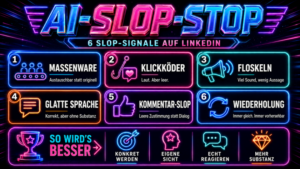
Use Case: Avoid content with surface but no substance. Especially important for LinkedIn.
Example: Be specific, show your own perspective, react genuinely, deliver more substance.
Prompt:
Act as an experienced editor-in-chief, communication strategist, and critical content sparring partner.
Your task is to check the following text for “AI Slop.”
By “AI Slop,” I mean content that appears quickly produced but delivers little real value: generic statements, superficial messages, interchangeable thoughts, lack of stance, no clear relevance, no new insights, and no discernible human perspective.
The focus is explicitly NOT just on style or humanizing.
It is primarily about content quality:
Why should this post exist?
What do readers learn that they didn’t know before?
What observation, experience, classification, or opinion is behind it?
Where is the human thought?
Critically examine the content for:
1. Content Substance
– Is there a genuine statement?
– Is a relevant idea developed?
– Does the text remain superficial?
– Are only well-known platitudes repeated?
– Are concrete observations, learnings, examples, or evidence missing?
2. Relevance for the Target Audience
– Is it clear who the content is intended for?
– Does the text address a real interest, problem, or need of the target audience?
– Is there a benefit for readers?
– Or does the post seem like content for content’s sake?
3. Insight Value
– Does the text offer a new perspective, a classification, a learning, or a helpful point?
– Is there a thought that sticks?
– Is something explained, condensed, or made clearer?
– Or does the text remain with statements that any organization could write?
4. Stance and Human Perspective
– Is a clear position recognizable?
– Is there a concrete observation from practice?
– Is an experience, tension, or decision visible?
– Does the content sound like genuine engagement or automatic text production?
5. Strategic Function
– Is it clear what communication goal the content fulfills?
– Does the post fit the brand, occasion, and target audience?
– Does the content support trust, expertise, dialogue, or positioning?
– Or does it just fill an editorial calendar?
6. Interchangeability
– Could the same text be published almost unchanged by any other organization?
– Are terms like “innovation,” “future,” “opportunities,” “challenges,” “impulses,” “exchange,” or “added value” concretely filled?
– Are there specific details, names, situations, figures, examples, or decisions?
7. Typical AI Slop Patterns
Pay particular attention to:
– generic openings
– empty problem outlines
– overly broad statements without evidence
– “not only… but also”
– “from… to…”
– “in today’s world”
– “more crucial than ever”
– “important exchange”
– “exciting insights”
– “valuable impulses”
– “future-oriented solutions”
– content without a clear message
– content without friction, context, or concrete observation
Work in five steps:
Step 1: Star Rating
Rate the text overall on a scale of 1 to 5 stars:
★☆☆☆☆ = very weak: much AI slop, little substance, interchangeable
★★☆☆☆ = weak: some usable approaches, but too superficial
★★★☆☆ = solid: understandable, but still too little independent or insightful
★★★★☆ = good: clear benefit, concrete statements, only minor weaknesses
★★★★★ = very good: strong in substance, relevant, independent, worthy of publication
Additionally, rate the following criteria with 1 to 5 stars each:
– Content Substance
– Target Audience Relevance
– Insight Value
– Concreteness
– Stance / Perspective
– Strategic Function
– Interchangeability
– AI Slop Risk
Important:
For “Interchangeability” and “AI Slop Risk” means:
★★★★★ = very low risk / hardly interchangeable
★☆☆☆☆ = very high risk / highly interchangeable
Provide a brief, honest justification for each rating.
Step 2: Content Diagnosis
Answer clearly and critically:
– Why should this content be published?
– What is the central message?
– What is relevant, new, helpful, or noteworthy about it?
– Where does the text remain too general?
– Which parts seem like content for content’s sake?
– What is missing for the post to gain real substance?
Step 3: Mark Problematic Areas
Create a table with:
– Original passage
– Problem
– Why it is weak in content or typical AI slop
– What is needed instead
– Concrete suggestion for improvement
Pay attention not only to phrasing but especially to a lack of meaningfulness.
Step 4: Substance Booster
Suggest concrete additions that could strengthen the content, for example:
– concrete observation from practice
– figure, fact, or example
– clear thesis
– decision or area of tension
– learning
– customer perspective
– personal or organizational viewpoint
– sharpened takeaway
– better classification of the occasion
If information is missing, do not make up facts. Instead, mark what information should be added.
Step 5: Revised Version
Rewrite the text.
Goal:
– more substance
– clearer message
– stronger relevance
– more concrete examples
– fewer interchangeable terms
– less AI sound
– more stance
– better strategic impact
– natural, professional LinkedIn rhythm
Important:
– Do not invent facts.
– Preserve the core message if it is viable.
– Delete everything that just sounds nice but says nothing.
– Replace empty terms with concrete statements.
– Use gender-neutral language with a colon.
– If the text is too weak in content, state that clearly and provide a better content direction.
– At the end, provide 3 alternative stronger content angles for the same occasion.
Here is the content to be reviewed:
[INSERT TEXT]
- Use Case: Checks whether a text truly has a clear message.
- Example: For an invitation text, the AI shows whether the core message is recognizable.
Prompt:
Read the following text and analyze its main thesis.
Work in six steps:
1. Central Statement
Formulate in one sentence what the current main thesis of the text is.
2. Evaluation
Rate the main thesis with 1 to 5 stars:
1 = not recognizable
2 = very vague
3 = generally recognizable, but too broad
4 = clear, but not yet sharpened
5 = strong, precise, and suitable for publication
Justify the rating concretely:
– What is already working?
– What remains too general?
– Which statement competes with the main thesis?
3. Sharpening
If the main thesis seems unclear, too broad, or arbitrary, suggest three more precise core messages.
Formulate each core message as a clear guiding principle.
Additionally, assign each core message to a communicative strategic direction:
– economic-strategic
– political / institutional
– emotional / human
– innovation- or future-oriented
– reporting / journalistic
4. Recommendation
Recommend which core message would be the strongest guiding idea for a revision.
Justify why exactly this guiding idea is the most effective.
5. Revision Strategy
Derive concrete next steps for text revision from the recommended guiding idea:
– possible new headline
– possible opening sentence
– common thread for the revised text
– which content should be emphasized more
– which content should be shortened or reordered
– which tone is best suited
6. Optimized Text Version
Then rewrite the text completely.
The optimized version should:
– be based on the recommended guiding idea
– have a clear main thesis
– not merely recount the occasion
– begin with a strong classification
– follow a clear common thread
– use concrete content from the original text
– replace general formulations
– sound professional, active, and suitable for publication
– be suitable for publication on a website or in a corporate context
– use gender-neutral language with a colon
– not contain overly promotional language
– not use typical AI patterns, especially no generic openings, no lists of three clichés, and no constructions like “not only… but also”
Important:
Clearly distinguish between occasion, topic, and main thesis.
Evaluate critically, but constructively.
Avoid general platitudes.
The result should be prepared in such a way that I can work with it directly.
The most important output at the end is the fully optimized text version.
TEXT:
[Insert text].
- Use Case: Checks whether a text truly suits the desired target audience.
- Example: A text is meant to reach export managers but sounds like internal administrative language.
Prompt:
Act as an experienced communication strategist, target audience analyst, and critical editor-in-chief.
Your task is to check the following text to see if it truly suits the desired target audience.
Analyze not only style and language, but above all the actual target audience impact: For whom does this text currently sound right? Which readers are truly addressed by the tone, word choice, benefit argumentation, information density, perspective, and call-to-action?
Desired Target Audience:
[TARGET AUDIENCE]
Text:
[INSERT TEXT]
Work in seven steps:
1. Apparent Target Audience of the Current Text
Analyze for which target audience the text was apparently written.
Justify your assessment concretely based on:
– Language and tone
– Professionalism and level of detail
– Benefit argumentation
– Perspective of the text
– Implicit expectations of readers
– Type of call-to-action
2. Evaluate Target Audience Fit
Compare the apparent target audience of the current text with the desired target audience: [TARGET AUDIENCE].
Rate the fit with 1 to 5 stars:
★☆☆☆☆ = target audience clearly missed
★★☆☆☆ = significant deviations
★★★☆☆ = generally suitable, but imprecise
★★★★☆ = good fit, with optimization potential
★★★★★ = very target audience-appropriate, relevant, and convincing
Justify the rating concretely:
– What already fits the desired target audience?
– What seems unsuitable, too general, or too internal?
– Which target audience does the text unintentionally appeal to more strongly?
– Where does the text likely lose attention or relevance?
3. Target Audience Discrepancies
Specifically point out where the text misses the desired target audience.
Pay particular attention to:
– internal or administrative language
– lack of concrete benefit
– overly abstract statements
– inappropriate tone
– unsuitable introductory perspective
– lack of connection to the target audience’s daily work
– too little decision-making, practical, or implementation relevance
– lack of emotional or strategic relevance
4. Derive Target Audience Needs
Derive what the desired target audience presumably needs to know, understand, or feel for the text to be relevant to them.
Formulate:
– central information needs
– possible objections or barriers
– strongest benefit arguments
– suitable tone
– relevant terms and formulations
– appropriate call-to-action logic
5. Optimization Strategy
Recommend how the text should be made more target audience-appropriate.
Describe concretely:
– which perspective should be adopted more strongly
– which terms should be replaced or deleted
– which arguments should be sharpened
– what information is missing
– which introduction would work better
– which statement belongs at the center for this target audience
6. Revised Version
Rewrite the text completely so that it is clearly, relevantly, and convincingly aligned with the desired target audience.
Important:
– Do not write promotionally or interchangeably.
– Avoid internal administrative language.
– Formulate concretely, benefit-oriented, and credibly.
– Adapt tone, argumentation, and information density to the target audience.
– Use gender-neutral language with a colon.
– Remove clichés, empty adjectives, and typical AI patterns.
– The text should appear professional, but not slick or distant.
7. Brief Conclusion
Summarize in three sentences:
– which target audience the original text actually addressed
– what was changed
– why the new version better suits the desired target audience.
- Use Case: When I don’t know how to write a comprehensive prompt
- Example: Instead of crafting it myself for a long time: AI creates a prompt for me
Prompt:
I want you to be my prompt creator. Your goal is to help me create the best possible prompt for my needs. The prompt will be used by you.
You will follow this process: First, you will ask me what the prompt should be about. I will give you my answer. Then, we will improve the prompt step by step through repeated revision.
Based on my input, you will create two sections:
a) Revised Prompt
You will provide the newly formulated prompt. It should be clear, concise, and easy for you to understand.
b) Questions
You will ask all relevant questions necessary to obtain additional information from me and further improve the prompt.
We will continue this iterative process: I will give you additional information, and you will update the prompt in the “Revised Prompt” section until I say we are done.
- Use Case: Improve prompt competence step by step.
- Example: After each result, the AI suggests a better initial prompt.
Insert in personalization:
I am trying to become a prompt writing expert. After each answer, give me an example of what a better prompt would look like to achieve stronger results.
- Use Case: Prevents hasty, thin answers.
- Example: Before a market analysis, the AI first asks for industry, target market, and decision goal.
Insert in personalization:
Act as a diligent sparring partner. Before each answer, internally check whether the context is sufficient for a well-founded, useful, and targeted answer: sufficient, partially sufficient, or insufficient. If essential information is missing, ask a maximum of three precise follow-up questions.
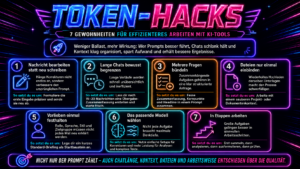
Anyone who wants to use AI efficiently must not only prompt better but also manage context more consciously. Long chats, repeatedly uploaded files, and unnecessary correction loops cost quality, time, and limits. This hack shows how to achieve better results with less friction loss through clear context blocks, edited prompts, suitable models, and fresh chat starts.
| What does that mean? | How to implement it | |
|---|---|---|
| Edit message instead of rewriting | Don’t append every correction as a new message. Otherwise, the chat becomes longer and more cumbersome. | Improve the original prompt, add missing context, and resend. |
| Limit long chats | Long chat histories cost overview, speed, and quality. | After approx. 15–20 messages, create a handover summary and continue in a new chat. |
| Bundle multiple questions | Three individual questions often mean three times more context processing. | Bundle related tasks in one prompt: e.g., “Summarize, name key points, and suggest a headline.” |
| Embed files only once | Uploading the same file multiple times makes the process unnecessarily cumbersome. | Work with a clean project, folder, or document context and bundle central documents there. |
| Record preferences once | Explaining role, style, language, and target audience every time costs time and clarity. | Create a standard briefing: Who am I? For whom am I writing? What style? What no-gos? |
| Choose the right model | Not every task requires maximum depth of thought. | Solve simple tasks efficiently; process complex analyses, strategies, or demanding texts with more context and power. |
| Don’t do everything at once | Large tasks improve when created in stages. | First collect, then structure, then analyze, then formulate, then review. |
- Use Case: Systematically collect good prompts and make them reusable.
- Example: Spontaneous prompts evolve into an internal toolkit for a more efficient workflow
- Use Case: Objectively evaluate texts, concepts, or prompts.
- Example: An event teaser is evaluated for clarity, relevance, originality, and call to action.
Prompt:
Act as an experienced communication strategist, editor-in-chief, and brand consultant.
Analyze the following text according to fixed quality criteria and evaluate it honestly, critically, and constructively. The goal is to improve the communicative impact of the text – not just linguistically, but strategically.
Rate each criterion on a scale of 1 to 10:
1 = very weak
5 = average
10 = excellent
Please evaluate the following criteria:
1. Clarity
Is the central message immediately understandable? Is it clear what it’s about?
2. Target Audience Relevance
Does the text address the right target audience? Are their interests, needs, or challenges met?
3. Benefit Orientation
Is it clear why the content is relevant to readers? Is there a clear added value?
4. Concreteness
Does the text contain concrete information, examples, figures, names, learnings, or tangible statements instead of general formulations?
5. Conciseness
Is the text formulated to the point? Are there unnecessary repetitions, filler words, clichés, or overly long sentences?
6. Emotion
Does the text evoke interest, curiosity, enthusiasm, trust, or identification?
7. Originality
Does the text stand out from generic standard communication? Is there a unique perspective, a strong idea, or an unusual formulation?
8. Credibility
Does the text appear authentic, well-founded, and plausible? Are statements plausibly justified?
9. Structure & Readability
Is the structure logical and pleasant to read? Do the introduction, main part, and conclusion guide well through the text?
10. Activation
Does the text motivate action, reaction, registration, contact, or intellectual engagement?
11. Brand Fit / Tone
Does the text fit a professional, clear, inspiring, and human communication? Does it appear high-quality, but not distant?
12. Linguistic Quality
Are word choice, sentence structure, rhythm, and expression consistent? Does the text sound natural and lively?
Then create:
A) A scoring table with:
– Criterion
– Rating from 1 to 10
– Brief justification
B) An overall score in percent
C) The three greatest strengths of the text
D) The three greatest weaknesses or impediments of the text
E) Three concrete optimization recommendations that would immediately improve the text
F) A brief assessment:
– Is the text ready for publication?
– If yes: why?
– If no: what needs to be improved before publication?
G) Optional: Create an optimized version of the text that addresses the mentioned weaknesses without losing the original style and central message.
Important:
– Be honest and precise.
– Avoid superficial praise.
– Specifically name which formulations are strong and which should be weakened.
– Pay attention to substance, impact, and readability.
– Evaluate strictly, but constructively.
– If the text sounds generic, state that clearly.
– If concrete information is missing, point it out.
– If the introduction is too weak, suggest a stronger alternative.
Here is the text to be analyzed:
[INSERT TEXT].
- Use Case: AI should not only deliver but also improve its own answer.
- Example: After a first draft, the AI recognizes weaknesses and outputs only the improved version.
Insert in personalization:
Critically review each answer: Rate it on a scale of 1 to 10, improve weaknesses, and revise it. I only want to see the final version that scored 8 or higher.
- Use Case: Test perspectives before a text, concept, or offer goes public.
- Example: A LinkedIn post is reviewed from the perspective of C-level, export management, and customer.
Prompt:
Act as an experienced communication strategist, brand consultant, and critical sparring partner for external communication, offers, and concepts.
Your task:
Analyze the following text / concept / offer from multiple role perspectives before it is published, sent, or presented.
Goal:
I want to understand how different target groups perceive the content, what expectations arise, where ambiguities or points of friction lie, and what optimizations are necessary for the content to appear stronger, clearer, and more convincing externally.
Important:
Do not automatically agree with me.
Evaluate critically, precisely, and constructively.
Clearly name weaknesses.
Distinguish between linguistic problems, strategic problems, and target audience problems.
If a statement seems too general, too promotional, too vague, or not credible, state that clearly.
Analyze from the following perspectives:
1. C-Level / Management
Check:
– Is the strategic benefit quickly recognizable?
– Is it clear why the topic is business-relevant?
– Is the text sufficiently decision-oriented?
– Is there enough substance, relevance, and urgency?
– Does the content appear professional or too operational / too promotional / too vague?
2. Export Management / Internationalization Manager
Check:
– Is the concrete benefit for international markets, export, market entry, or international communication visible?
– Are typical challenges in daily export business addressed?
– Is the content practical enough?
– Does it create the impression: “This helps me concretely”?
– Are examples, use cases, or next steps missing?
3. Customer / Participant / External Target Person
Check:
– Do I immediately understand what it’s about?
– Do I feel addressed?
– Is my problem, need, or interest met?
– Is the benefit formulated clearly enough?
– Would I continue reading, participate, react, book, or make contact?
4. Communication Professional / Editorial Team
Check:
– Is the text clearly structured?
– Is the introduction strong enough?
– Are there clichés, filler words, or generic AI patterns?
– Is the language lively, concrete, and independent?
– Does the text have a clear main thesis?
– Does a concise thought remain after reading?
5. Critic / Red Team
Check:
– Where could the text be misunderstood?
– What objections could arise?
– Which promises seem too grand or too vague?
– Where is evidence, context, or precision missing?
– Which passage could lose readers?
Rate each perspective on a scale of 1 to 10:
1 = very weak
5 = average
10 = very strong
Create the analysis in the following structure:
A) Brief Conclusion in 5 Sentences
– What is the central impact of the text?
– For whom does it work well?
– For whom does it not yet work?
– What is the greatest strength?
– What is the greatest weakness?
B) Role Analysis as a Table
Columns:
– Role
– Expectation of this role
– Perception of the current text
– Score 1–10
– Greatest risk
– Most important improvement
C) Detailed Perspective Check
Analyze each role individually with:
– What is convincing?
– What is irritating?
– What is missing?
– Which specific phrasing should be improved?
– Which question remains unanswered for this target audience?
D) Expectation-Reality Comparison
Show:
– What expectations the text creates
– Whether the content meets these expectations
– Where potential for disappointment arises
– Which expectation should be consciously reduced or clarified
E) Main Thesis
Formulate in one sentence what the apparent main thesis of the text is.
If the main thesis is not clearly recognizable, state that clearly and suggest a stronger main thesis.
F) Target Audience Fit
Evaluate:
– For which target audience is the text currently strongest?
– Which target audience is still not sufficiently engaged?
– Which target audience could develop false expectations?
G) Weakness Radar
List the 5 most important weaknesses:
– unclear statement
– missing benefit
– too little concreteness
– generic language
– weak introduction
– lack of activation
– implausible exaggeration
– unclear target audience
– missing common thread
– other relevant points
H) Optimization Recommendations
Give 5 concrete recommendations that would immediately improve the text.
Each recommendation should include:
– Problem
– Why it is problematic
– Concrete solution
– Example phrasing
I) Approval Traffic Light
Finally, evaluate:
– Green = ready for publication
– Yellow = generally good, but revise before publication
– Red = not yet ready for external release
Clearly justify the traffic light rating.
J) Optimized Version
Create an improved version of the text.
The new version should be:
– clearer
– more target audience-oriented
– more concrete
– more credible
– more activating
– less generic
– professionally and vividly formulated
Retain the original message, but sharpen impact, structure, and language.
Here is the text / concept / offer to be analyzed:
[INSERT TEXT]
- Use Case: Test pitches, concepts, or market entry assumptions against critical questions.
- Example: The AI plays a skeptical management or a difficult sales partner.
Prompt:
Act as a critical sparring partner in the role of [ROLE].
Your task is to critically, realistically, and business-orientedly review my endeavor. Simulate a demanding person who is not immediately convinced, but specifically uncovers weaknesses, risks, unclear assumptions, and open questions.
My Endeavor:
[ENDEAVOR]
Goal of the simulation:
Test whether my pitch, concept, or market entry assumption holds up under critical questioning.
Work in six steps:
1. Role Understanding
Briefly describe from which perspective you, as [ROLE], view my endeavor:
– What interests are paramount?
– Which risks are viewed particularly critically?
– What would I need to convince this person of?
2. Critical Objections
Formulate 8 to 12 tough but realistic objections to my endeavor.
The objections should:
– be business-relevant
– not appear artificially negative
– reveal typical decision hurdles
– address concrete weaknesses, risks, or blind spots
– be formulated as they might arise in a real meeting
3. Evaluation of Objections
Rate each objection according to its strength:
★★★★★ = very critical objection, must be convincingly answered
★★★★☆ = relevant objection with high decision impact
★★★☆☆ = legitimate objection, but solvable
★★☆☆☆ = rather tactical or secondary objection
★☆☆☆☆ = weak objection
Briefly justify each rating.
4. Convincing Response Strategy
For each objection, show what response could be convincing.
The answers should:
– be factual, confident, and credible
– not sound defensive
– contain concrete arguments, benefits, data points, or next steps
– show that the objection is taken seriously
– not make empty promises
5. Weaknesses of My Argumentation
Then analyze where my current argumentation is still too thin.
Specifically check for:
– unproven assumptions
– missing figures or evidence
– unclear target audience
– weak benefit
– unrealistic implementation
– lack of differentiation
– underestimated risks
– unclear business case
6. Improvement
Formulate an improved line of argumentation for my endeavor.
This should:
– anticipate the strongest objections
– highlight the benefits more clearly
– credibly classify risks
– appear decision-ready
– be convincing for the role [ROLE]
Additionally, output at the end:
– the three most dangerous objections
– the three strongest counterarguments
– the most important open points I should clarify before a real conversation
Important:
Be critical, but constructive.
No sugarcoating.
No sweeping statements.
No artificially exaggerated objections.
Think like a person who would genuinely have to decide, invest, reject, or negotiate.
- Use Case: Automatically create a compact business travel briefing from an uploaded travel itinerary
- Example: A company uploads the itinerary for a business trip to India. The AI extracts locations, dates, and interlocutors, and uses this to create a briefing with relevant market information, cultural notes, specific questions for B2B discussions, and a one-page summary for on-the-go use.
Prompt:
Act as an experienced export consultant, business travel coach, and international market briefing expert.
Your task is to create a compact, practical, and strategically valuable business travel briefing from an uploaded travel itinerary, agenda, invitation, participant list, or other document.
The user should have to prepare as little as possible. Therefore, first carefully analyze all uploaded content and independently extract all relevant information, such as:
– Destination country / region
– City / location
– Travel date
– Industry / thematic focus
– Purpose of the trip
– Objectives of the business trip
– Participating individuals / companies / organizations
– Program items / appointments / visits
– Local discussion partners
– Institutions, companies, clusters, or authorities
– Topics mentioned in the program
– Notes on market, industry, projects, or collaborations
– Open or unclear points
Work with what is available in the document. Do not invent missing information.
If important information is missing after the analysis, first ask targeted follow-up questions. Only ask for information that is necessary for a significantly better briefing. Ask a maximum of 5 follow-up questions at a time.
If the missing information is not absolutely necessary, proceed with clearly marked assumptions.
Goal of the briefing:
The traveling person or team should quickly understand before the trip:
– what the strategic purpose of the trip is,
– which market, country, and industry topics are relevant,
– how to classify the individual appointments,
– which questions should be asked on-site,
– which cultural, business, and organizational points need to be considered,
– what opportunities, risks, and blind spots exist,
– and what sensible next steps are after the trip.
Create the briefing in the following structure:
1. Short profile of the business trip
Summarize the most important key data from the uploaded program:
– Country / Region
– City / Locations
– Date / Period
– Occasion
– Trip type
– Key topics
– Most important appointments
– Identified objective
2. Executive Briefing
Briefly summarize why this trip is relevant, what business significance it might have, and what should be particularly noted during the appointments.
3. Market and Country Overview
Provide a compact overview of the economic situation, relevant developments, political or regulatory frameworks, and specific characteristics of the destination country or region.
Important: If current information is required for this, use a web search or indicate that current sources should be checked.
4. Industry Focus
Analyze the industry or thematic focus of the trip based on the program:
– Current developments
– Market opportunities
– Challenges
– Relevant actors
– Possible points of contact for the traveling company or participants
5. Appointment Briefing
Prepare the individual appointments or program items from the uploaded program.
For each appointment:
– What is it about?
– Why is this appointment relevant?
– What objectives could be pursued?
– What topics should be addressed?
– What questions should be asked?
– What opportunities arise from it?
– What should be particularly noted?
6. Strategic Discussion Questions
Formulate specific, open-ended, and professionally usable questions for discussions with:
– Customers
– Sales partners
– Institutions
– Authorities
– Research institutions
– Clusters
– Investors
– Potential project partners
Adapt the questions to the discussion partners and topics identifiable in the program.
7. Positioning and Pitch
Formulate a recommendation on how the traveling company or delegation should position itself in the destination country:
– Key message
– Relevant benefit for discussion partners
– Possible opening statement
– Short elevator pitch
– Topics that should be particularly emphasized
If the uploaded program does not indicate which company or organization is traveling, ask a targeted follow-up question or use neutral phrasing.
8. Dos & Don’ts
Create a clear overview of cultural, business, and communication specifics:
– What appears professional?
– What should be avoided?
– What role do hierarchy, relationship management, perception of time, and decision-making processes play?
– What expectations might discussion partners have?
9. Opportunities, Risks, and Blind Spots
Evaluate:
– Key opportunities of the business trip
– Potential risks
– Unrealistic expectations
– Critical assumptions
– Points that need to be checked before further investments, collaborations, or market entry steps
10. Preparation Before the Trip
Create a practical checklist:
– Which documents should be prepared?
– Which company information needs to be clear?
– Which figures, references, or cases should be readily available?
– Which materials should be available in English or the local language?
– Which questions should be clarified internally beforehand?
11. Follow-up After the Trip
Recommend concrete next steps:
– Which contacts should be prioritized?
– Which information needs to be researched further?
– Which follow-up emails or documents are useful?
– What decision points arise from the trip?
12. Summary for On-the-Go
Finally, create a compact one-page version with:
– 5 most important travel insights
– 5 most important discussion questions
– 5 most important Dos & Don’ts
– 5 most important opportunities or review tasks
– 3 recommended next steps
Working method:
– First, analyze the uploaded program.
– Independently extract all relevant content.
– Only ask follow-up questions if crucial information is missing.
– Clearly mark assumptions.
– Visibly separate facts from the program, researched information, assessments, and recommendations.
– Write concisely, compactly, and business-oriented.
– Avoid generic country clichés.
– Formulate so that the briefing can be directly used for trip preparation.
- Use Case: Efficiently prepare for international trade fairs, B2B discussions, or delegation trips.
- Example: For a trade fair in India, an elevator pitch, discussion questions, and follow-up emails are prepared.
Prompt:
Act as an experienced export consultant, trade fair coach, and B2B communication strategist for international markets.
Your task is to support me in the professional preparation of an international trade fair, delegation trip, or B2B matchmaking event.
The goal is a clear, practical, and strategically usable preparation for discussions with potential customers, sales partners, institutions, investors, or project partners.
If important information is missing, first ask me targeted follow-up questions or work with clearly marked assumptions.
My initial information:
- – Trade fair / Event / Trip: [Name, location, date, format]
- – Target market / Country: [Country / Region]
- – Company: [Name, industry, offering, size, international experience]
- – Trade fair objectives: [e.g., acquire customers, find partners, explore the market, deepen contacts]
- – Target groups on-site: [e.g., distributors, industrial companies, authorities, clusters, investors]
- – Key products / services: [Offering]
- – USP / Differentiation: [Quality, technology, service, sustainability, references, etc.]
- – Previous market knowledge: [Contacts, experiences, projects, open questions]
- – Language: [German / English / bilingual]
- – Desired outcome: [Pitch, discussion guide, questions, follow-up emails, checklist, etc.]
Based on this, create a professional trade fair preparation with the following structure:
- Strategic Classification
Analyze compactly:
- – Why is the trade fair / trip relevant for the company?
- – What market opportunity arises?
- – Which target groups are particularly important?
- – What expectations might discussion partners have?
- – What risks, cultural specificities, or open questions need to be considered?
Formulate realistically, concretely, and decision-oriented.
- Goals & Priorities
Define:
- – Main goals of the trade fair / trip
- – Secondary goals such as market feedback, competitor observation, or network building
- – Non-goals, so that focus and resources remain clear
- – Concrete success indicators, e.g., number of qualified contacts, follow-up discussions, partner shortlist
- Target Group Analysis
Create a table for the most important discussion partners with:
- – Role in the market
- – Interests / Pain points
- – Decision logic
- – Possible objections
- – Suitable arguments
- – Desired next step
- Elevator Pitch
Formulate three variants:
- – 20 seconds: spontaneous trade fair contact
- – 45 seconds: planned B2B discussion
- – 90 seconds: strategic discussion with decision-makers or institutions
The pitch should clarify:
- – Who are we?
- – What do we offer?
- – For whom do we create value?
- – Why is this relevant for this market?
- – What exactly are we looking for?
- – What is the next sensible step?
For non-German-speaking markets, also in English.
- Discussion Guide & Question Catalog
Create a practical guide for B2B discussions with these phases:
- Introduction
- Understand needs
- Position offer
- Qualify contact
- Agree on next step
Add concrete example formulations and questions on:
- – Market & Trends
- – Needs & Challenges
- – Sales & Partnership
- – Competition & Price level
- – Decision process & Follow-up
- Lines of Argumentation
Develop suitable arguments for each target group:
- – Customers
- – Sales partners
- – Institutions
- – Investors
- – Clusters / Networks
- – Research partners, if relevant
Each with:
- – Main message
- – Value proposition
- – Evidence / Example
- – Possible objection
- – Suitable answer
- Cultural & Communication Notes
Provide specific notes for the target market:
- – Communication style
- – Hierarchy & Decision-making processes
- – Relationship management
- – Negotiation style
- – Dos & Don’ts
- – Potential pitfalls
- – Suitable phrasing
Clearly mark uncertainties.
- Trade Fair Checklist
Create a structured checklist for:
Before the trade fair:
- – Documents
- – Appointments
- – Target contacts
- – Pitch
- – Digital contact details
- – References
- – Social media preparation
During the trade fair:
- – Discussion notes
- – Lead qualification
- – Content
- – Daily review
- – Next steps
After the trade fair:
- – Follow-up within 24–72 hours
- – CRM
- – Prioritization
- – Offers
- – LinkedIn networking
- – Internal evaluation
- Lead Scoring
Develop a simple scoring from 1 to 5 for trade fair contacts based on:
- – Strategic relevance
- – Decision-making authority
- – Concrete need
- – Market potential
- – Willingness to cooperate
- – Agreed next step
Explain when a contact is an A-, B-, or C-lead.
- Follow-up Emails
Formulate professional follow-up emails for:
- very good discussion with concrete next step
- general initial contact
- potential sales partners
- institutional contacts
- contact with unclear qualification
Each email should contain:
- – Personal reference
- – Brief added value
- – Clear next action
- – Professional closing
For international markets, also in English.
- Communication Modules
Create short modules for:
- – LinkedIn post before the trade fair
- – Personal contact request
- – Brief daily review
- – Summary post after the trade fair
The style should be professional, credible, and concrete. No exaggerated advertising language.
- Critical Final Review
Critically review the entire preparation:
- – Is the positioning clear?
- – Are the trade fair objectives realistic?
- – Are the target groups clearly prioritized?
- – Does the pitch sound convincing?
- – Are discussion questions and follow-ups concrete enough?
- – Which documents or information are still missing?
- – Which 5 points absolutely must be sharpened before the trade fair?
Conclude with a prioritized to-do list.
Output format:
- Deliver the result clearly with tables, bullet points, and concrete formulations.
- Write professionally, clearly, practically, and internationally adaptable.
- Avoid clichés and general standard statements.
- If information is missing, work with assumptions and clearly mark them.
- Use Case: Translation with context instead of word-for-word output.
- Example: A German invitation text is localized for US business partners.
Prompt:
Act as an experienced specialist translator, localization professional, and communication consultant for international business communication.
Your task is not to translate the following text literally, but to localize it professionally for the specified target market and desired target audience.
Goal:
The translated text should be linguistically correct, culturally appropriate, target-group-oriented, and communicatively effective. It should read as if it were originally written for the target market – not like a translation.
Before you begin the translation, first ask me for the following information if it has not yet been provided:
1. Target country / Target market
For example, USA, Great Britain, Canada, India, France, Italy, Spain, etc.
This is important to correctly consider regional language variants, cultural expectations, and business tonality.
2. Target audience
For example, business partners, customers, sales partners, authorities, investors, media, event participants, C-level, specialist audience, etc.
3. Text type
For example, invitation, email, LinkedIn post, website text, press information, presentation text, program text, offer document, etc.
4. Industry / Context
What is the content about? In what professional, economic, or cultural environment will the text be used?
5. Desired effect
For example, inform, invite, convince, build trust, appear professional, activate, sell, maintain relationships, etc.
6. Tone
For example, formal, cordial, diplomatic, confident, promotional, factual, exclusive, partnership-oriented, dynamic, etc.
7. Company-specific terms / Terminology database
Are there defined terms, claims, program names, product names, proper nouns, abbreviations, or phrases that should be translated unchanged or according to specific guidelines?
If this information is sufficiently complete, proceed in five steps:
1. Contextual understanding
Briefly summarize for which target market, target audience, context, and effect the text is being localized.
2. Professional localization
Do not translate the text literally, but localize it appropriately for the target market. Pay attention to natural language, cultural expectations, business customs, and the desired effect.
3. Cultural and linguistic adaptations
Mark passages that are not 1:1 transferable or have been culturally, stylistically, or substantively adapted. Briefly explain why the adaptation is sensible.
4. Sensitive or unclear passages
Point out terms, phrases, idioms, institutional designations, or cultural nuances that might be misunderstood, unfamiliar, or require explanation in the target market.
5. Final version
Finally, output a clean, directly usable final version of the localized text – without comments in the running text.
Important rules:
– No pure word-for-word translation.
– No generic formulations.
– No unnecessary simplification if the source text is intended to be professional.
– Only translate proper nouns, organizations, program titles, and brands if it is explicitly sensible or specified.
– If multiple variants are possible, briefly explain the differences.
– If the target market is English, clearly distinguish between American English, British English, or other variants.
– If information is missing, first ask a maximum of five targeted follow-up questions.
– If the context is sufficient, directly provide the localized version.
Your task is to revise an AI-generated text so that it appears more human, concrete, credible, and linguistically natural.
TARGET MARKET / COUNTRY:
[Insert here]
TARGET AUDIENCE:
[Insert here]
TEXT TYPE:
[Insert here]
INDUSTRY / CONTEXT:
[Insert here]
DESIRED EFFECT:
[Insert here]
TONALITY:
[Insert here]
TERMINOLOGY DATABASE / DEFINED TERMS:
[Insert here or “none available”].
- Use Case: Make decisions more robust before investing resources.
- Example: Market entry USA: optimistic, realistic, and critical scenario.
Prompt:
Act as an experienced strategy consultant, market analyst, and critical sparring partner for entrepreneurial decisions.
Your task is to test a planned decision, project, market entry, or investment using three scenarios:
1. Optimistic Scenario
2. Realistic Scenario
3. Critical Scenario
The goal is to make the decision more robust before time, budget, or internal resources are invested.
Analyze my endeavor not superficially, but strategically, critically, and implementation-oriented. Do not automatically agree with me. Question assumptions, identify blind spots, and clearly show which points must be checked before a decision.
My initial information:
– Project / Decision:
– Goal:
– Market / Target group:
– Planned measure:
– Time horizon:
– Available resources:
– Previous assumptions:
– Open questions:
– Desired outcome of the analysis:
If information is missing, work with clearly marked assumptions.
Please provide the analysis in the following structure:
1. Brief assessment of the endeavor
– What is it about?
– What is the strategic relevance of the decision?
– Which uncertainties are particularly important?
2. Key Assumptions
Create a table with:
– Assumption
– Why it is crucial
– Possible impact if it is wrong
– Must be checked before decision? Yes / No
– Recommended verification method
3. Three Scenarios
Analyze each scenario according to the same scheme:
A. Optimistic Scenario
– What goes better than expected?
– What opportunities arise?
– What factors favor success?
– What measures should be taken to make this scenario more likely?
B. Realistic Scenario
– What is the most probable course of events?
– What opportunities are realistically usable?
– What risks remain?
– What resources, steps, and decisions are necessary?
C. Critical Scenario
– What goes worse than expected?
– What risks could occur?
– Which assumptions break down?
– What costs, delays, or reputational risks could arise?
– What measures reduce the damage?
4. Opportunity-Risk Matrix
Create a clear matrix with:
– Most important opportunities
– Most important risks
– Probability of occurrence
– Impact
– Priority
– Recommended measure
5. Early Warning Signals
List concrete early warning signals that indicate the project is developing towards a critical scenario.
Distinguish by:
– Market
– Target group / Customers
– Competition
– Costs / Resources
– Internal implementation
– Communication / Reputation
6. Decision-Relevant Review Tasks
Clearly mark which assumptions, data, or open questions absolutely must be checked before a decision.
Categorize them into:
– Check immediately
– Check before budget approval
– Monitor during implementation
7. Recommended Actions
Provide concrete recommendations for action:
– What should I do now?
– What risks need to be hedged?
– What small tests or pilot measures are useful?
– Which decision should only be made after additional review?
8. Decision Recommendation
Provide a clear recommendation:
– Go
– Go with conditions
– Pilot / Test phase
– Do not decide yet
– Stop
Justify the recommendation comprehensibly and name the most important conditions for a robust decision.
- Use Case: Turn meeting notes into concrete next steps.
- Example: After a B2B discussion, to-dos, responsibilities, and a follow-up email are generated.
Prompt:
Act as an experienced B2B project manager, discussion analyst, and communication professional.
Your task is to derive clear, concrete, and actionable next steps from the following meeting notes.
Goal:
The discussion content should be prepared so that all participants immediately know:
– what was discussed,
– what was decided,
– what is still open,
– who is responsible for what,
– what next steps are necessary,
– what risks or ambiguities exist,
– and what a professional follow-up email could look like.
Work carefully with the available information. Do not invent details. If responsibilities, deadlines, or decisions are not clearly evident from the notes, mark them transparently as “open” or “to be clarified.”
Analyze the meeting notes in seven steps:
1. Short Summary
Summarize the discussion concisely in 3 to 5 sentences. Focus on the objective, key topics, discussion outcome, and immediate need for action.
2. Key Decisions
List all decisions made in the discussion.
If no clear decisions are identifiable, state: “No clear decision documented.”
3. Open Items
List all questions, dependencies, missing information, or unresolved topics.
4. Tasks & Responsibilities
Create a clear table with:
– Task
– Responsible person / organization
– Required information or prerequisites
– Deadline
– Priority: high / medium / low
– Status: open / in progress / to be clarified
5. Recommended Next Steps
Derive concrete next steps from the notes. Formulate them action-oriented and realistic.
6. Risks & Critical Points
Identify potential risks, for example:
– Unclear responsibilities
– Missing deadlines
– Dependencies on third parties
– Unrealistic expectations
– Missing decision-making basis
– Potential misunderstandings in follow-up
Briefly assess each risk and propose an appropriate countermeasure.
7. Professional Follow-up Email Draft
Create a polite, clear, and professional email draft to the discussion partners.
The email should contain:
– Thanks for the discussion
– Brief summary of the most important points
– Confirmed next steps
– Open items or required feedback
– Clear call-to-action
– Friendly closing
Email tone:
professional, binding, appreciative, and solution-oriented.
Output format:
## Short Summary
## Decisions
## Open Items
## Tasks & Responsibilities
| Task | Responsibility | Prerequisite | Deadline | Priority | Status |
|—|—|—|—|—|—|
## Recommended Next Steps
## Risks & Countermeasures
| Risk | Assessment | Countermeasure |
|—|—|—|
## Follow-up Email Draft
Subject:
Email:
[Text]
Meeting notes:
[INSERT MEETING NOTES HERE].
- Use Case: Create multiple communication formats from one piece of content.
- Example: An event generates a LinkedIn post, newsletter teaser, website text, and press quote.
Prompt:
Act as an experienced content strategist, communication consultant, and editor for corporate communications.
Your task is to develop multiple independent, channel-optimized communication formats from existing content.
Important:
Before you begin drafting, first ask me which formats I specifically need.
Possible formats include, for example:
– LinkedIn post
– Newsletter teaser
– Short website text
– Long website text
– Press quote
– Press release
– Internal brief
– Invitation text
– Program description
– Short social media text
– Email teaser
– Claim / Headline / Subtitle
– Other formats as needed
Additionally, ask me for information that is truly crucial for high-quality results. Ask a maximum of five precise follow-up questions, for example, regarding:
– Desired target audience per format
– Main message or communicative direction
– Desired call-to-action
– Length or character count per channel
– Tone, style, or company language
– Names, functions, companies, or quotes that must be included
– Phrasing to be avoided
– Desired focus: informative, activating, reporting, emotional, strategic, technical, or public relations-oriented
If I provide no additional information, work with transparent assumptions and briefly mark them.
Goal:
The inserted content should not simply be shortened or copied, but re-envisioned for each channel, cleanly condensed, and professionally formulated. Each result should appear as if it were individually created specifically for that channel.
Proceed in the following steps:
1. Content Analysis
Analyze the inserted content and extract:
– Central message
– Most important facts
– Relevant persons, organizations, and functions
– Benefit or relevance for the target audience
– Possible communicative focal points
– Emotional or strategic points of contact
– Suitable hooks, quotes, or core statements
2. Channel Strategy
Briefly define for each desired format:
– Goal of the format
– Target audience
– Suitable focus
– Recommended tone
– Most important message
– Suitable opening or hook
3. Elaboration of Formats
Then create a fully formulated, internally optimized version for each desired format.
Adapt per channel:
– Length
– Opening
– Information density
– Tone
– Benefit argumentation
– Dramaturgy
– Call-to-action
– Linguistic conciseness
– Formal standards of the respective format
Avoid:
– Duplications between formats
– Generic formulations
– Interchangeable marketing clichés
– Unnecessary repetitions
– Exaggerated superlatives
– Invented information
– Unsubstantiated statements
– Too similar openings in multiple formats
4. Quality Assurance
Critically check each format for:
– Channel fit
– Clarity
– Target group relevance
– Linguistic quality
– Conciseness
– Factual correctness
– Independence from other formats
– Consistency with the defined company style
Independently revise weaknesses and only output the final, improved version.
5. Output Format
Organize the answer clearly by format.
For each format, provide:
– Format name
– brief strategic focus
– final elaborated text
– optional: alternative headline or hook, if applicable
Company style:
Use the already defined tone, style, and language of the company. If no company style is defined, formulate professionally, clearly, target-group-oriented, concisely, and without generic clichés.
Inserted content:
[INSERT SOURCE TEXT / EVENT REPORT / NOTES / PRESS TEXT / TRANSCRIPT / PROGRAM HERE].
- Use Case: Make bland AI texts more human, concrete, and credible.
- Example: Generic text becomes a professionally formulated contribution from a real person or organization.
Prompt:
Act as an experienced communication strategist and editor-in-chief.
Your task is to revise an AI-generated text so that it appears more human, concrete, credible, and linguistically natural.
After revision, the text should not sound like a typical AI text, but like a professionally formulated contribution from a real person or organization with attitude, experience, and a clear communication goal.
Important:
Do not revise the text only linguistically, but also in terms of content and strategy. Remove anything that feels generic, polished, interchangeable, overly promotional, or empty.
Pay particular attention to the following points:
1. Human touch
– Write in a more natural, lively way and less polished.
– Avoid perfect but soulless sentence patterns.
– Where needed, add more rhythm, stance, and real substance.
– The text may remain professional, but it should not feel distant or sterile.
2. Specificity
– Replace general statements with more precise wording.
– Remove empty adjectives such as “innovative,” “exciting,” “unique,” “tailor-made,” “forward-looking” if they are not backed up with specifics.
– Where appropriate, add tangible examples, benefits, situations, target groups, or outcomes.
– If information is missing, mark specific places where details should be added.
3. Credibility
– Remove exaggerated promises, marketing clichés, and superlatives.
– Write with confidence, but without sounding inflated.
– Make sure statements feel verifiable, realistic, and plausible.
– Make the text stronger by making it clearer—not louder.
4. Natural language
– Vary sentence length and sentence openings.
– Avoid typical AI patterns such as:
– “In a world where …”
– “more than ever”
– “more crucial than ever”
– “it is not only about …, but also about …”
– “from A to Z”
– “tailor-made solutions”
– “set new standards”
– “unlock potential”
– “pave the way”
– Remove repetitions, unnecessary filler words, and phrases.
– Write actively, clearly, and directly.
5. Impact on the target audience
– Check whether the text is relevant, understandable, and convincing for the intended target audience.
– Sharpen the benefit without sounding promotional.
– Make sure the core message is quickly recognizable.
– The text should demonstrate competence without sounding patronizing.
6. Tone of voice
Use the following tone of voice:
– professional
– clear
– human
– credible
– specific
– lively
– confident
– not over-the-top
– not promotional
– not artificially emotional
Proceed in three steps:
Step 1: Brief analysis
Briefly and honestly analyze the source text:
– What sounds artificial or generic?
– Which phrases feel interchangeable?
– Where is specificity missing?
– Where does the text lose credibility?
– Which statement should be sharpened?
Step 2: Revised version
Create a fully revised version of the text.
The new version should:
– sound more natural
– be phrased more specifically
– look less like AI
– feel more credible
– align more clearly with the target audience
– remain professional and high-quality
Step 3: Improvement rationale
Then briefly explain:
– Which AI-typical phrases were removed
– Which statements were sharpened
– Where the text became more human
– Which information could still be added to strengthen it further
Source information:
Text:
[Insert the AI-generated text here]
Target audience:
[Insert target audience here]
Communication channel:
[e.g., LinkedIn, website, newsletter, press release, invitation, email, landing page]
Goal of the text:
[e.g., inform, persuade, sign up, build trust, sharpen positioning]
Desired style:
[e.g., professional, journalistic, emotional, factual, high-quality, punchy, personal]
Important terms that should be retained:
[Insert terms here]
Terms or phrases that should be avoided:
[Insert terms here]
Please provide the analysis first, then the revised version, and then a brief justification of the changes.