
15. July 2026 Latest News Austria

Styrian exports 2025: Stable despite challenging framework conditions

Styria’s export economy proved robust in 2025

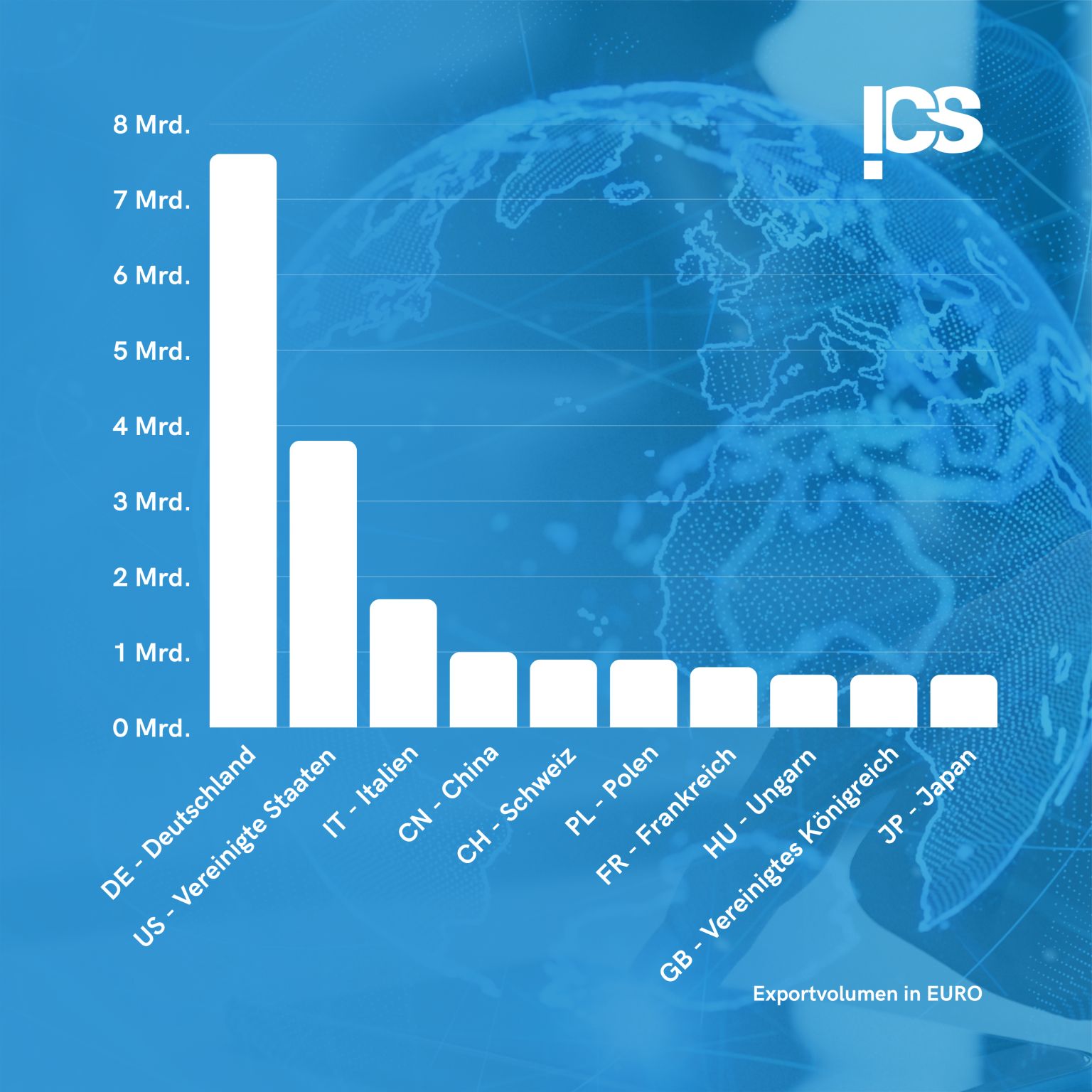
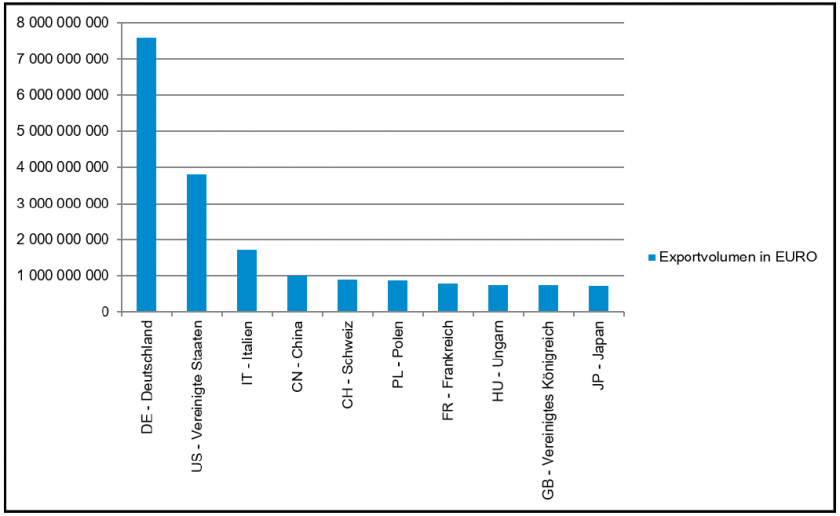
Despite a difficult international environment, Styrian goods exports held up relatively well, declining by around 1.0% to 28.2 billion euros. Germany remained the engine of export growth despite subdued economic activity, accounting for around a quarter of all Styrian exports. Markets such as Poland, the Czech Republic and Spain also developed dynamically within Europe.

Notably, Styrian exports to the USA also grew in 2025, contrary to the very negative Austria-wide trend, and with export growth of almost 20% to Canada and more than 5% to Mexico, the USMCA free trade area between the USA, Mexico and Canada strengthened its importance for Styria. The development of exports to South America varied greatly in 2025. Within the Mercosur region, exports to Brazil in particular increased significantly.

In addition to Japan, which has already been mentioned, Malaysia also absorbed significantly more Styrian exports in 2025 than in the comparable period of the previous year, and exports to India also continued to rise steadily last year, with an increase of over 4%. However, our companies recorded a decline of almost 30% in exports to China, while imports from China rose by over 28%, likely due to recent developments in the automotive sector.

Encouraging and extremely important from a macroeconomic perspective: Styria also recorded a substantial trade surplus of around 7.5 billion euros last year.

“The current figures show that Styrian companies are holding their own successfully, while international markets are changing noticeably. Alongside Europe’s strength, new sales markets are gaining in importance. For export-oriented companies, it is therefore becoming even more important to build up strategic markets such as India today, to identify market opportunities in other growth markets at an early stage and seize them quickly, and to continuously further develop their international orientation.”

Karl Hartleb, Managing Director of ICS


Different developments by sector

There were clear differences across product groups. While pharmaceutical products and wood products were able to increase strongly overall, iron and steel products recorded declines.

The most important export goods remain vehicles and vehicle parts, accounting for almost 20% of total export volume. They are followed by machinery and electrical goods.

Josef Herk, President, WKO Styria

“Foreign trade is not an add-on for Styria; it is the lifeline of our prosperity—around every second euro of value added is generated in foreign markets. The fact that we will reach exports of 28.2 billion euros in 2025 despite the crisis environment shows the strength of our businesses, for which we— in the interest of competitiveness—urgently need to further improve the framework conditions, especially with regard to labour and energy costs. In order to be able to hold their own in this challenging environment, we offer our businesses a dense support network: from ICS and tailored export consulting through to our globally active Außenwirtschaft Austria network with around 100 offices in 70 countries.”

Josef Herk, President, WKO Styria

Willibald Ehrenhöfer, Provincial Councillor for Economic Affairs

“Exports are the fuel of our prosperity. We generate half of Styria’s value added in international markets. The domestic economy can therefore only grow if our companies achieve corresponding export successes. Given the difficult national and international framework conditions, the 2025 results are extremely respectable. Our export-oriented businesses have proven to be very resilient despite major challenges, also compared with other federal states. It is particularly pleasing that exports to Germany increased significantly and that we were also able to achieve growth in other markets within the EU. It is therefore important, on the one hand, to view Europe even more strongly as a space of opportunity for our economy and, on the other hand, to consistently develop future markets outside Europe.”

Willibald Ehrenhöfer, Provincial Councillor for Economic Affairs

“Styrian industry continues to hold its own in an extremely difficult international environment, but momentum has noticeably slowed. The slight decline in goods exports is not an alarm signal, but a clear indication that geopolitical uncertainties, weaker demand in key markets and high location costs are continuing to put pressure on our export-oriented flagship companies. For industry, it is crucial that policymakers draw the right conclusions. We need to become more agile again, and we can achieve that through lower costs and less bureaucracy at home, as well as a state that reduces the tax and levy burden through structural reforms.”

Kurt Maier, President of IV Styria

“The present foreign trade balance shows that our companies are holding their own, but competition is becoming tougher in view of our unit labour costs—here, with an eye to the upcoming collective agreement negotiations, hopefully all parties involved are aware of their responsibility. In addition, sales markets are shifting rapidly—for example towards Japan or Poland—while Germany, as the most important market, is also recording growth. Especially now, Styria needs a clear foreign trade strategy, courage to enter new markets and reliable international trade agreements that reduce tariffs and create fair rules. The Provincial Committee for Foreign Trade supports businesses with practical advice, market checks, training, delegation trips and contacts with partners on the ground—from the first idea through to signing a contract abroad.”

Manfred Kainz, Chair of the Provincial Committee for Foreign Trade in the Styrian Chamber of Commerce

Your contact at ICS

Sandra Tanos, Export Consultant at ICS

Sandra Tanos

Senior Project Management | Export Consulting